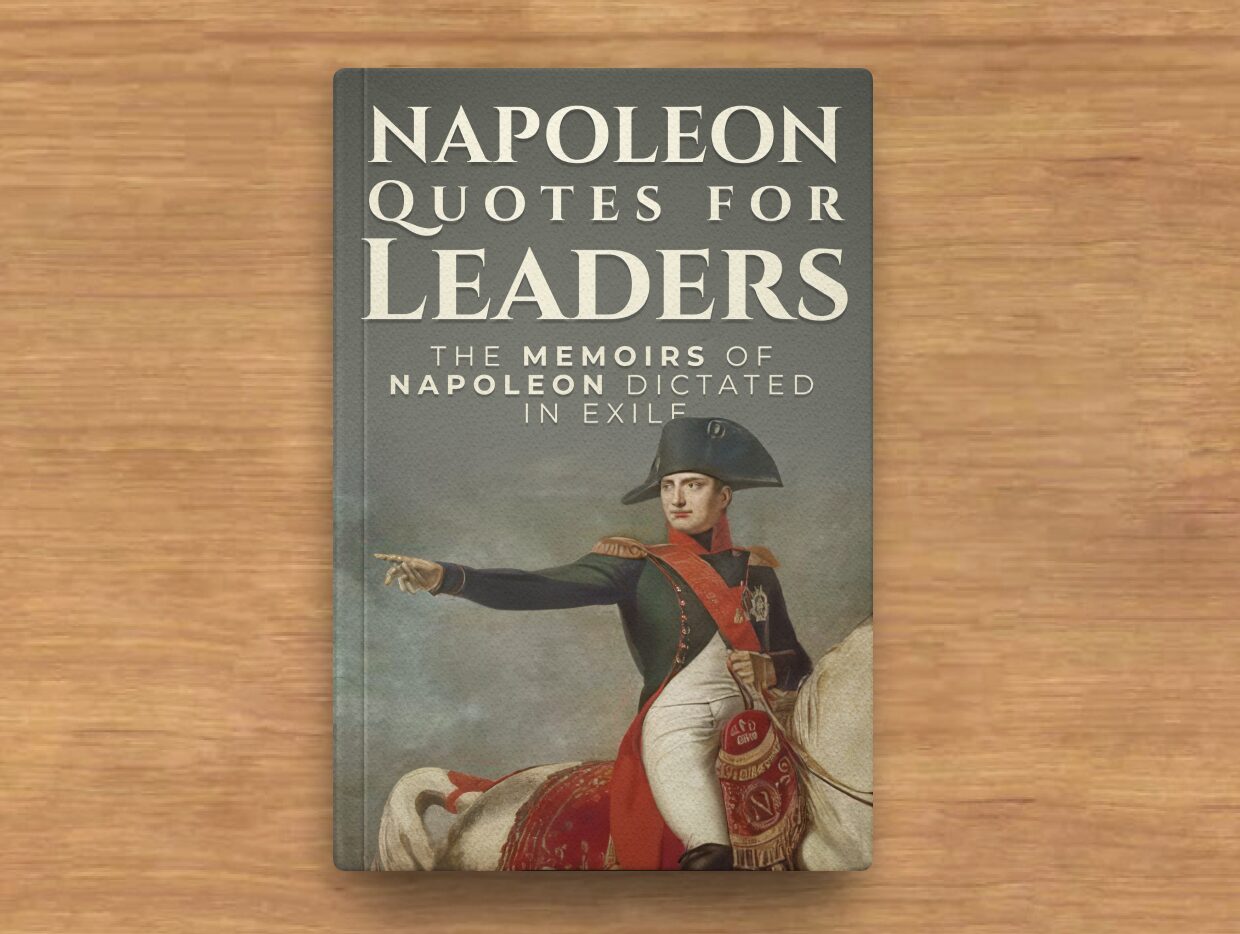
Napoleon’s Own
Words. Unfiltered. From Exile.
The memoirs of Napoleon, told by himself.
Not retold by a historian. Not filtered through a courtier’s
admiration or an enemy’s contempt. Dictated by the Emperor to his valet
de chambre at Saint Helena, in the raw voice of a man who had nothing
left to lose and nothing left to prove.
Original source: Bibliothèque nationale de France, Paris,
1829
How I Found This Text
I stumbled onto this text by accident. I was building an AI
application designed to coach people using the writings and biographies
of ancient leaders. Mostly Alexander the Great and Machiavelli. The idea
was simple: take the values that persist across centuries and use them
as a filter for what is real. Because if you pick up any book, watch any
series, or follow any advice produced in the last ten years, most of it
will lead you straight into failure. Modern content is simulation.
Worse: it is often a pure inversion of the truth.
So I fed my application the great texts. Arrian’s Anabasis
alone is nearly two months of reading. Then, at some point, the AI I was
working with suggested I add Napoleon’s biographies. Being French, I
went straight to the Bibliothèque nationale de France and downloaded
these memoirs.
“This small text, buried in an ocean of classical sources,
took over the entire application. Ask any question about leadership,
ambition, will, or strategy, and the system would answer with Napoleon.
Every time.”
At that point, I knew I was onto something. When a modern AI system,
trained on the entire breadth of classical literature, consistently
returns one text above all others as the most relevant source on
leadership, that text deserves your attention.
Why This Book Is Different
Napoleon Bonaparte dictated his memoirs to his valet de chambre
during his exile on Saint Helena. They were published in Paris in 1829.
This is not a biography, not a historian’s account, not a secondhand
retelling. This is the Emperor’s voice, unfiltered.
This Is Not the
Mémorial de Sainte-Hélène
People frequently confuse Napoleon’s dictated memoirs with the
Mémorial de Sainte-Hélène by Emmanuel de Las Cases. That is a
different work entirely, written by an observer. What you hold here are
Napoleon’s actual words: raw, uncompromising, and startlingly
modern.
Dictated Directly by an
Emperor
This is one of the only autobiographical texts in history dictated
directly by a reigning emperor. Napoleon spoke these words himself at
Saint Helena, to be recorded by Frédéric Lullin de Châteauvieux. The
original was published in 1829 by Philippe, libraire, Paris.
Harder to Find Than It Should
Be
Overshadowed by Las Cases and buried in the archives of the
Bibliothèque nationale de France, this text was never widely reprinted.
This edition restores it: carefully translated from the original French
primary source, edited for modern readers, and paired with 8 historical
illustrations.
Napoleon’s Words on
Leadership
Every quote in this book comes from Napoleon’s dictated memoirs. Not
from a secondary compilation. Not attributed without source. Drawn
directly from the 1829 primary text.
“I succeeded in what I undertook because I willed it: my will was
strong and my character decisive. I never hesitated: this gave me the
advantage over everyone.” – Chapter 2: Youth and Formation
“There is only one secret to leading the world: to be strong,
because in strength there is neither error nor illusion; it is the truth
laid bare.” – Chapter 5: The Consulate
“I then regarded myself, for the first time, no longer as a
simple general, but as a man called to influence the fate of nations. I
saw myself in history.” – Chapter 3: Toulon and the Italian
Campaign
“They all counted on me, because they needed a sword. I counted
on no one.” – Chapter 5: The Consulate
“One does well only what one does oneself.” – Chapter 3:
Toulon and the Italian Campaign
“This system will outlive me, and I have left Europe a legacy it
can no longer repudiate.” – Chapter 6: The Empire
What You Will Discover
Inside
- Napoleon’s framework for making decisions under extreme
pressure - How he turned impossible odds into decisive victories at Arcole,
Rivoli, and Marengo - The mindset that transformed setbacks into stepping stones, and a
young officer into an Emperor - His principles of leadership that built and sustained the largest
European empire since Rome - Strategic lessons from the Egyptian Campaign: logistics, morale, and
calculated risk - Why Napoleon believed willpower was the single most important
quality of a leader - The art of war as practiced by history’s greatest military
commander, in his own words - Timeless lessons on ambition, resilience, and execution for modern
entrepreneurs, founders, and executives
This Edition Includes
- 50 curated quotes from Napoleon’s dictated
memoirs - 8 historical illustrations from the Napoleonic
era - The original 1829 preface and Napoleon’s autograph
note to Dr. O’Meara - 8 chapters covering Youth, Toulon, Italy, Egypt,
the Consulate, the Empire, and the Fall - A detailed appendix with battle notes and campaign
context
Napoleon
vs. Marcus Aurelius: A Different Kind of Leadership Text
You might think of Marcus Aurelius’s Meditations as the
classic leadership text from antiquity. Here is why these memoirs are
something else entirely.
| Marcus Aurelius | Napoleon Bonaparte |
|---|---|
| Philosophy and contemplation | Strategy and execution |
| Inner reflection, Stoic detachment | Raw energy, relentless will |
| Silent on the question of how to win | Only about making it |
| Written for self-improvement | Dictated to prove and to teach |
| The voice of acceptance | The voice of conquest |
This is the roughest text you will ever encounter: the voice of a man
who believed in nothing but himself and artillery, the nec plus
ultra of his era. And that era’s ultimate weapon maps onto
ours.
Artillery was to the eighteenth century what artificial
intelligence is to the twenty-first: the force multiplier that reshapes
everything.
About the Editor
Alexandre Salvatore is a historian, AI developer,
and classical publishing enthusiast based in Paris. He specializes in
bringing forgotten primary sources back to modern readers, with a focus
on Napoleon and 18th-century French literature. He discovered Napoleon’s
dictated memoirs while building an AI coaching application using
classical leadership texts, and was struck by the raw power of
Napoleon’s voice in a text that had been buried for nearly two
centuries.
Frequently
Asked Questions About Napoleon’s Memoirs
What are
Napoleon’s memoirs dictated at Saint Helena?
Napoleon’s memoirs dictated at Saint Helena are a rare
autobiographical text in which Napoleon Bonaparte himself narrates his
life, campaigns, and political career. Unlike most accounts of Napoleon
written by historians or observers, these memoirs were dictated directly
by the Emperor to his valet de chambre during his exile on Saint Helena.
They were first published in Paris in 1829 by Philippe, libraire, under
the title Mémoires de Napoléon, écrits sous sa dictée à
Sainte-Hélène. The text covers Napoleon’s youth in Corsica, his
military campaigns in Italy and Egypt, the rise of the Consulate, the
Empire, and his eventual downfall.
What
is the difference between Napoleon’s memoirs and the Mémorial de
Sainte-Hélène?
These are two entirely different works that are frequently confused.
The Mémorial de Sainte-Hélène was written by Emmanuel de Las
Cases, who served as Napoleon’s companion on Saint Helena. Las Cases
recorded conversations and observations as an outside observer.
Napoleon’s memoirs, by contrast, were dictated directly by Napoleon
himself to his valet de chambre. They represent Napoleon’s own voice,
unfiltered by an intermediary, and offer a far more direct and personal
account of his life, decisions, and strategic thinking.
Why are Napoleon’s
original memoirs so rare?
Napoleon’s original dictated memoirs are rare because they were
overshadowed by the far more famous Mémorial de Sainte-Hélène
by Las Cases, which became the dominant Saint Helena text in popular
culture. The original memoirs, published in 1829 in Paris, were not
widely reprinted and gradually became buried in the archives of the
Bibliothèque nationale de France. Most readers and even historians are
unaware that Napoleon dictated his own account separately from Las
Cases’s work. This edition restores the original text, translated from
the French primary source held at the BnF.
What
can leaders and entrepreneurs learn from Napoleon’s memoirs?
Napoleon’s memoirs contain direct lessons on leadership,
decision-making under pressure, strategic thinking, and the willpower
required to build and sustain large-scale enterprises. Napoleon
discusses how he made decisions during the Italian Campaign, the
Egyptian expedition, and the formation of the Consulate and Empire. His
lessons cover turning setbacks into opportunities, the importance of
speed and decisive action, managing large organizations, and the role of
personal will in achieving extraordinary outcomes. These principles
apply directly to modern entrepreneurs, executives, and anyone in a
leadership role.
How
does this edition differ from other Napoleon quote books?
This edition is built directly from the original 1829 French primary
source, Napoleon’s memoirs dictated at Saint Helena, sourced from the
Bibliothèque nationale de France. Unlike generic Napoleon quote
compilations that gather sayings from various secondary sources, every
quote in this book comes from Napoleon’s own dictated memoir. The
edition includes 50 curated quotes with full historical context, 8
historical illustrations from the Napoleonic era, the original 1829
preface, Napoleon’s autograph note to Dr. O’Meara, and a detailed
appendix with battle notes and campaign context.
What did
Napoleon say about leadership and willpower?
Napoleon’s most famous statement on willpower from his memoirs is: “I
succeeded in what I undertook because I willed it: my will was strong
and my character decisive. I never hesitated: this gave me the advantage
over everyone.” He also stated: “There is only one secret to leading the
world: to be strong, because in strength there is neither error nor
illusion; it is the truth laid bare.” Napoleon believed that willpower
was the single most important quality of a leader, more decisive than
tactical genius or material resources.
“This text transformed me. I hope it will energize you, and
transform you too.”
Read Napoleon’s Own Words
Also available in French: Citations de Napoléon pour
Entrepreneurs
Napoleon Quotes for Leaders: The Memoirs of Napoleon Dictated in
Exile Original source: Mémoires de Napoléon, écrits sous sa
dictée à Sainte-Hélène (Paris, 1829) – Bibliothèque nationale de
France